

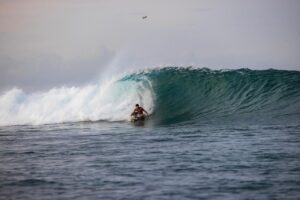




Ocean Park is a public recreation and wave-pool concept proposed for Seaside Lagoon in Redondo Beach by Allen Sanford and the team behind the California Surf Club (CSC). The proposal is still in the conceptual design and approval process, so details including the site plan, wave-pool technology, pricing and final amenities remain subject to change.
Sanford hopes to reinvigorate the aging Seaside Lagoon property with a new public lagoon, a compact-but-fun surf pool and expanded recreational and picnic space that would be accessible throughout the year. His plan also leads to revenue increases for Redondo harbor businesses and the city of Redondo Beach.
Seaside Lagoon is a longtime fixture of Redondo Beach’s King Harbor waterfront. Constructed in 1962, the 1.4-million-gallon man-made saltwater lagoon includes a sandy shoreline, picnic areas and children’s play features. It traditionally operates for public swimming from Memorial Day through Labor Day.
Current admission is $8-$10 per day per person.

In recent years, the lagoon’s aging infrastructure has become increasingly difficult and expensive to operate. Historically, seawater has been brought into the facility, chlorinated for public swimming and then dechlorinated before being discharged into King Harbor under a state-regulated water-quality permit.
As environmental requirements have become more stringent and the infrastructure has aged, maintaining compliance has become increasingly challenging. The City recently reported approximately $175,000 in water-quality penalties covering a two-year period. A pump failure also forced the lagoon to close for roughly two weeks during the 2025 season and cost approximately $60,000 to repair.
Redondo Beach has secured a $10 million state appropriation and committed another $1 million in city funds toward rehabilitation of the lagoon.
The current City plan would replace the aging water system and create a modern lagoon isolated from King Harbor. It would also include additional minor updates to the surround park, but as you can see in the rendering below, the customer experience will be the same as it is today.

The existing California Surf Club is a 22,000 sq. ft. facility that provides it members with two restaurants, lounge, an outdoor event area and a popular series of speakers, live music and other activities. The club is already a thriving community hub, hosting frequent indoor and outdoor events and recreational activities. They’ve hosted a series of speakers on topics ranging from surfing to filmmaking.
Sanford and his team now hope to partner with the City to transform Seaside Lagoon into a more active year-round public recreation destination tentatively named “Ocean Park”.
The Ocean Park concept includes a replacement swimming lagoon, public recreation and picnic areas, and a compact wave pool capable of producing surfable waves. The entire facility would be publicly accessible without a California Surf Club membership.
The image below shows an early conceptual layout. The final site plan, pool dimensions, wave-pool technology and other major design details are still being evaluated.

The current concept calls for general park admission of approximately $10 per person, with surfing in the wave pool priced separately. The surf-session price has not yet been determined. For context, sessions at commercial wave pools elsewhere commonly cost on the order of $100, although pricing varies substantially by facility, wave type and session format.
Their commitment to sharing the joy of surfing is also driving the CSC to donate at least 100,000 waves each year to nonprofit organizations such as Culture Club and the Jimmy Miller Memorial Foundation, which use surfing to support Wounded Warriors and other communities through therapeutic and recreational programs.
Lastly, the team is also exploring ways to make some form of surfing available for park customers without requiring purchase of a full surf session. One early concept would use a pool configuration that produces a secondary inside wave suitable for children and beginning surfers.
Ocean Park would occupy a constrained site between Redondo Beach Pier and King Harbor, surrounded by marinas, restaurants, hotels and other waterfront businesses.
Because of the limited footprint and the desire to preserve substantial space for non-surfing recreation, the surf lagoon would likely be considerably smaller than destination wave pools such as Surf Ranch, Waco Surf or many of the newer Wavegarden Cove developments.
The project team is targeting a fun, approachable wave rather than a high-performance surf destination. The current objective is to produce both left- and right-breaking waves suitable primarily for beginning and intermediate surfers while using as little land as practical.
Early calculations suggest rides of up to approximately 12 seconds, although ride length will ultimately depend on the pool geometry and wave-generation technology selected.
The exact wave frequency, surfer capacity and hourly throughput have not yet been determined.
Those numbers will depend heavily on the wave technology selected, the final pool geometry, the number of simultaneous surfing zones and the operating format. They will be important metrics to watch as the concept develops because they will ultimately determine both the user experience and the economics of the surf component.
One of the strongest arguments for Ocean Park is its potential to turn an occasionally visited waterfront property into a more active year-round destination.
Additional visitors drawn by the opportunity to surf great waves in a idyllic environment could generate business for nearby hotels, restaurants, bars, retailers and recreational operators while also producing additional hotel, sales and other tax revenue for Redondo Beach.
According to preliminary estimates from project proponents, Ocean Park could generate nearly $1 million per year in additional City tax revenue through increased visitor spending. Preliminary modeling also projects a 10% increase in occupancy at the 4 hotels and 14 restaurants within 1000 feet of the proposed wave pool.
Those figures should be viewed as early projections rather than independently verified economic-impact estimates. They will be revisited as the project advances and more detailed financial and visitor-demand studies become available.
The table below summarizes and compares the two plans based on very early estimates and rounded numbers:
| Lagoon infrastructure upgrade (current city plan) | Ocean Park (plan proposed by California Surf Club) | |
| Redondo visitors and residents get… | An experience similar to what they have today, with chlorinated water. | An experience similar to what they have today, with a smaller wave pool. A wave pool. |
| Year round access | No, limited to 3 summer months. | Yes, 12 months per year. |
| Cost to customers | $10 per person. | $10 per person to access everything except surfing the wave pool. |
| Benefit to local businesses | $0 | 10% increase in occupancy rates for nearby hotels and an unknown increase in revenue for other nearby businesses. |
| Incremental city revenue | $0 (or somewhere less than zero when you include the opportunity cost of a 3 vacant acres 9 months of the year). | ~$1M in tax revenue increase based on increased visitor spend on local business. |
For South Bay residents who support adding a public wave pool to the Seaside Lagoon redevelopment, now is a useful time to make that support known.
A Redondo Beach City Council meeting is scheduled for Tuesday, September 15, 2026 at 6:00 p.m. at the City Council Chamber, 415 Diamond Street, Redondo Beach. Show up and voice your support for the plan.
Residents can also contact their district representative and the mayor directly:
| Representative | Office | |
| Jim Light | Mayor – Citywide | James.Light@redondo.org |
| Brad Waller | District 1 | Brad.Waller@redondo.org |
| Chadwick Castle | District 2 | Chadwick.Castle@redondo.org |
| Paige Kaluderovic | District 3 | Paige.Kaluderovic@redondo.org |
| Zein Obagi Jr. | District 4 | Zein.Obagi@redondo.org |
| Scott Behrendt | District 5 | Scott.Behrendt@redondo.org |
Public comments can also be sent to CityClerk@redondo.org for distribution as part of the City Council process.
If you support a public wave pool at Seaside Lagoon, tell the City why: year-round public recreation, opportunities for beginning surfers and children, activation of the waterfront, support for nearby businesses, or simply the chance to give Redondo Beach a unique coastal attraction.
Ocean Park is still only a concept. Community input now could help determine whether it moves forward.