




The Surf Ranch is a Wave Pool from Kelly Slater, one of the most successful professional surfers of all time. Its was the first wave pool to use the wave pool technology from his company, the Kelly Slater Wave Co, and it set the bar for high-quality man-made waves.
The Surf Ranch in Lemoore is primarily known for creating long, high-performance waves that provide opportunities for barrels, plenty of turns and (if you rip) airs. It can generate lefts or rights that can be surfed for around 45 seconds, making it the longest wave pool of its type. The wave can reach 6.5 feet on the face (2m), and at that size its “experts only”, but it can be downsized and slowed down to suite beginner and intermediate surfers.
According to Adam Fincham, the chief scientist on the team, the Surf Ranch can generate about 12 different waves profiles ranging from the one you’ve seen in most of Surf Ranch videos to a 3 foot roller intended for beginners. At full power, the wave has a few different sections. The main/first barrel section on the right can cover a surfer for up to 14 seconds.
The Surf Ranch can generate one high performance waves every 4 minutes. Currents, water level fluctuations and turbulence (i.e. seiching) are bi-products of each wave. Therefore, for those perfect waves seen in many of the videos, the team typically recommends waiting 7-10 minutes between each wave depending on whether the surfers are prioritizing wave count or quality. The wind and the type of wave generated also plays into this equation: smaller waves require less energy and subsequently, less settling time.
If you are headed to the Surf Ranch, you’ll want to check the water temp with your hosts before you get there. Wetsuits are often a good call.
In terms of boards, Kelly told Surfline “their favorite board in the ocean will be their favorite one at the pool. Because for the most part, you’re dealing with a wave that’s pretty fast. Anything you’d like at a nice, three- to four-foot day at Lowers you’ll probably like at Surf Ranch.” The wave can also be tuned down for beginners or longboarders, so if you only ride a long board, bring it and the Surf Ranch will accommodate.
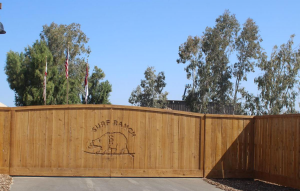
After driving three hours from Los Angeles or San Francisco, you enter the small town of Lemore and arrive at the Surf Ranch. The facility is surrounded by a fence and security cameras, but the entrance is welcoming with a beautiful hand-carved gate.
Upon arrival, you get a quick tour on your way to a locker with your name on it. Here you store your boards, etc. while you grab some food, get the safety speech and wait for your session.
When it’s your turn, you will be asked to paddle to the take off position which feels uncomfortably close to the track and foil lane. Only a thin net and about 10 feet separate you from the space where you know the foil will be plowing water in a matter of minutes. If that doesn’t get your blood flowing, then 30 second warning over the PA system and the sound of the motors revving up is sure to get your attention.
Depending on the fitness and talent level of the group you are with, you may or may not be better off surfing the entire length of the wave. Some groups choose to split the wave in half while others plan on surfing the full wave. The latter groups place backup surfers along the path of the wave in case someone falls early. Unless you have access to a ski and the skills for step-offs, Kelly recommends three to four people sitting at 20-pole intervals along the wave in case someone falls.
According to most surfers who opt for the most challenging wave profile, the wave feels faster than their natural counterparts. You also have to prepare for longer rides; in the ocean you spend a lot of time paddling and sitting. At the surf ranch, you spend a lot of time with your feet in the wax, standing up.
Between and after sessions, surfers have access to a locker room with showers and a hot tub to warm up.
The best winds for the Surf Ranch are no wind, but if it blows, west wind is the best wind. According to Kelly, “The typical wind is northwest, which is blowing offshore on the rights and onshore on the lefts. A west wind, in theory, would be offshore on both, based on the angle of the body of water.”
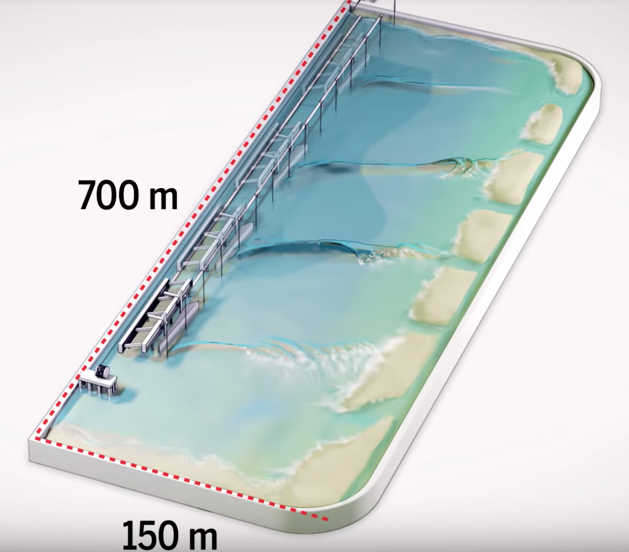
The Surf Ranch generates waves by driving a 100-ton foil through the water. The foil is attached to what the team calls “the vehicle” which sits on a track above the water. The vehicle gets moved up and down the track at 10 to 18 miles per hour by winches that sit at either end of the track. Electric motors power the winches. The winches are connected to the vehicle by cable. To generate a wave, the vehicle is pulled along the track the foil is dragged through the water. As the foil moves through the water, it creates a wave that propagates toward the shoreline where it encounters shallower water and breaks. The foil can be pulled in both directions, ie. up and down the track or (north and south according to the team). When the foil moves one way, it creates a right hand wave and when the foil moves the other way, it creates a left.
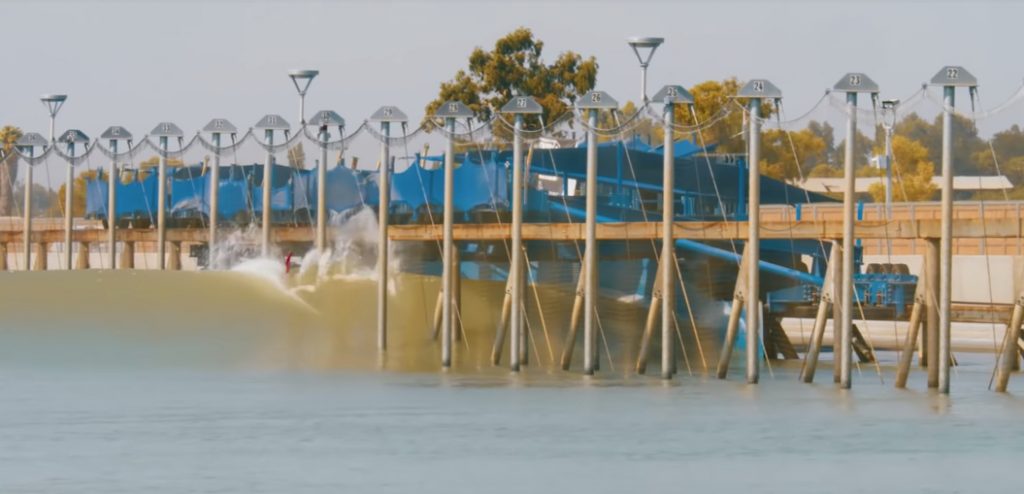
Although little is known about the shape of the foil (e.g. its obstructed from view by tarps), Fincham said that the foil design was inspired by Derek Garard Goring, who developed a method of generating “very nice waves with a paddle.” Kelly has described the as an “really inefficient boat hull”. However, what it lacks from a boaters perspective, it makes up from a surfer’s perspective: Kelly also says that 90% of the energy put into moving the foil is transferred into the water.
Though it’s not know how much energy is consumed to create each wave, it is known that the Surf Ranch helps protect the environment by powering 100% of the wave with solar energy they buy from PG&E.
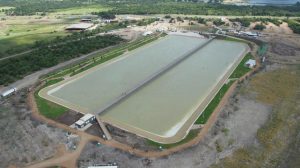
The pool is 700 meters long and 150 meters wide, and at its deepest point its only 9 feet deep. The wave breaks in water 3 to 4 feet deep, so its not uncommon to hit the bottom and/or get held down while you get swept along with the wave.
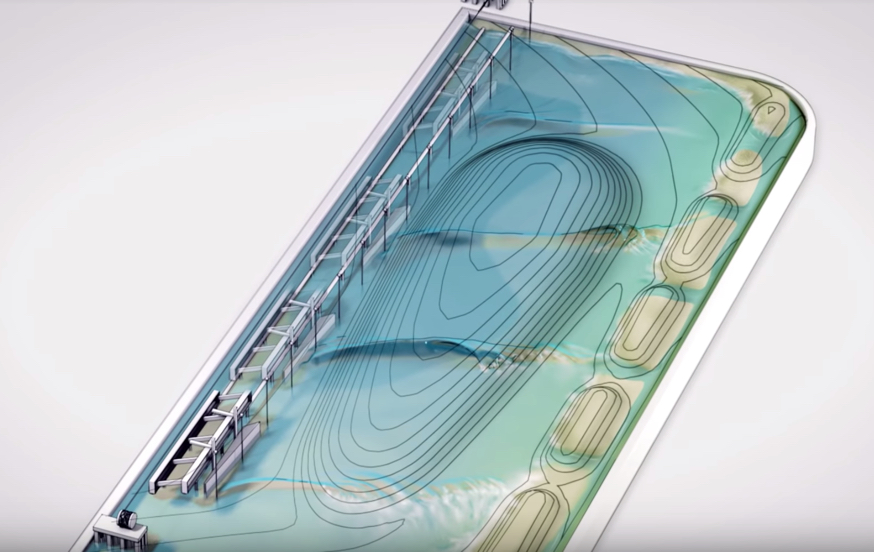
The various sections on the wave (e.g. the barrel sections or turn sections) are created by variations in the curvature of the bottom of the lake. The speed of the foil also affects the shape of the wave.
Gutters running the length of the pool capture the water and energy that comes from a wave, and help reduce the settling time.
The Surf Ranch pool is filled with 15 million gallons of fresh water that is UV and chlorine-treated.
The wave is controlled by a person sitting in a control tower overlooking the pool. Various wave profiles (shapes and sizes) are generated by changing the speed and angle of the foil (+/- 7 to 10º). The controller can pick from about 12 different wave profiles, each with a different name. According to Kelly there are five popular profiles. Kelly likes the “CT3”. In recent contests they’ve used the “CT3” on the left which produces slightly slower and more unpredictable waves. They’ve used the “CT2” on the right, which is faster and more reliably hollow through the middle section. They also have slower profiles for beginners which are smaller and don’t barrel.
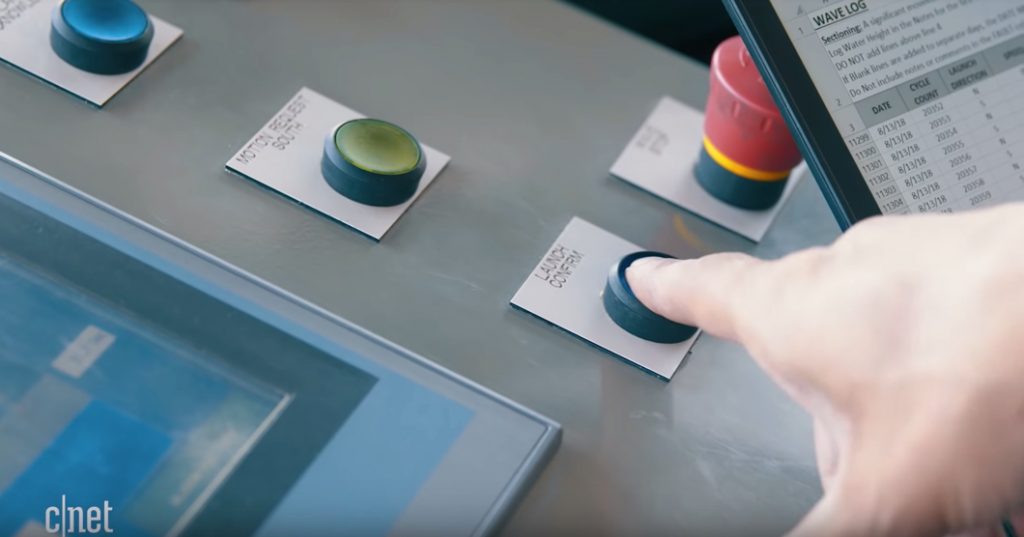
With the click of the blue “Launch Confirm” button seen on the Siemens-made control system above, the operator in the control tower can launch a wave.
The Surf Ranch is not officially open to the public. It’s primarily used by professional surfers for training and contests. But if you know the right people, and have the funds, you may catch the best wave of your life there. Full-day rental for you and your friends will run from $35k in the off-season to $55 during the summer months.
As part of special events, like the Freshwater Pro (formerly known as the Surf Ranch Pro), they often sell “experiences” that allow the buyers to surf the pool. For example, as part of the Founder’s Cup, the Surf Ranch sold tickets for a Surf Ranch Experience for just under $10,000. That included a one hour surf session in the pool plus VIP access to the Cup, parties, three night of lodging and other benefits.
If you are feeling lucky, there are occasionally contests and fundraisers like this one that give away tickets to a randomly selected Good Samaritan.
Kelly Slater started working on creating the wave in 2005, and the Kelly Slater Wave Company (KSWC) was founded in 2007 but it wasn’t until 2015 that the Surf Ranch waves were unveiled to the public.
Kelly started working with Adam Fincham in 2006, when Adam was at USC. Shortly thereafter Adam created a 2″ prototype wave and presented it to folks at Quiksilver (Kelly’s sponsor at the time). They decided to continue work, but outside USC.
From 2007 until 2012, Kelly and his team iterated on ideas, patent applications and built better prototypes in a discreet warehouse in Culver City, CA. Their early designs were based on doughnut shaped pools. However, that direction ran into some issues with a patent held by Greg Webber. Fincham also cited settling issues with the circular design, so KSWC was forced to go a different, more linear direction. The team has always worked on creating a surfable wave using a type of wave called a soliton. In fact this is one of the things that distinguishes it from Greg Webber’s designs.
Other engineers from USC were involved over those early years including, Larry Redekopp, Tony Maxworthy, and Fred Browand.
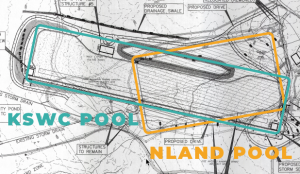
Then, In 2014, KSWC bought two man-made lakes and 20 surround acres in Lemore, CA for roughly $575,000.
Fincham and the rest of the team are notoriously tight-lipped about the technology and methods to create the waves at Surf Ranch, but Fincham did give this up in a Wired interview: they got inspiration from the Goring method (from Derek Gerard Goring) who developed a way to generate waves with a paddle. That inspiration guided the shape of a hydrofoil, which pushes water pushes it sideways.
On the morning of December 5, 2015, Kelly paddled into his first wave at the Surf Ranch and gets barreled for 30 seconds riding what was, according to him at the time, “The best man-made wave ever made.” The first video footage went viral and major media outlets all over the world opened many new eyes to the potential of wave pools.
The World Surf League saw the potential in surf pools, particularly the Surf Ranch, and subsequently bought a major stake in KSWC in May 2016. The name at that point changed to “the WSL Surf Ranch”, but the team still prefers to refer it simply as the Surf Ranch.
Extensive bottom adjustments were made in 2017 and “Surf Ranch 2.0” was launched.
In April 2018, the Kings County Planning Commission approved a proposed expansion plan from the Surf Ranch. That plan gives them permission to open for regular public use, including private surf lessons and up to 6 professional surfing events per year. As they’ve done in the past, the team plans to enhance some of the surfing events with live music, food and beverage vendors. They may also experiment with on-site tent and RV camping.
The expansion plans also include turning the second lake into another prototype wave pool, adding up to seven buildings for (10,000 square feet of new space) and expanding the land to 155 acres. The buildings would include:
At a total cost of $30 million to design and develop (as of 2018), the Surf Ranch wasn’t cheap. It’s undeniable, however, that it’s raised the bar significantly in the wave pool game. In fact, Matt Warshaw, the surf historian, says there are now two eras of surfing: before and after the Surf Ranch.
Sources: SurferToday.com, Surfline, CNET, Science Magazine, ESPN, WSL, KSWC, Wired