





Pacifica Surf Reef
An artificial reef for surfing and shoreline protection in Pacifica, CAAverage Reviews
Description
Erosion on the California coastline is a real, growing problem and the city of Pacifica is considering an artificial reef that would help protect the coastline and increase the quality of surf.
Pacifica, California sits on the Pacific coast about 15 miles south of San Francisco and is known for its long crescent-shaped Pacifica State Beach—commonly called Linda Mar Beach—which receives more than one million visitors annually and is one of the most popular beginner surf spots in the Bay Area.
Over the past several decades, the Pacifica shoreline has experienced significant erosion and coastal flooding, particularly the city’s iconic pier and the Sharp Park neighborhood. Waves increasingly overtop the existing seawall, threatening homes, utilities, and public infrastructure. The rising sea level and stronger winter storms are expected to accelerate these impacts. In response, the city has been planning a large Beach Boulevard Infrastructure Resiliency Project, estimated around $125 million, focused primarily on rebuilding or reinforcing seawalls and improving coastal access.
However, a group of local surfers, coastal engineers, and environmental advocates has proposed an alternative or complementary solution: an artificial reef north of the Pacifica Pier. Proponents hope a carefully designed reef could dissipate wave energy offshore, reduce erosion along the shoreline, and potentially create a wave that could benefit the local economy and surf culture.
As of 2026, the reef remains in the feasibility and study phase. The City of Pacifica and the San Mateo County sea-level-rise agency OneShoreline have applied for funding to conduct technical studies evaluating whether an offshore reef is viable. The proposed feasibility study would cost roughly $150,000, with half funded through a state shoreline-erosion grant.
Design and Construction Plans
The Pacifica reef proposal is still conceptual, but several key elements of its potential design have been described in planning documents and presentations.
The proposed reef would likely be located north of the Pacifica Municipal Pier, although there has been some consideration to placing the reef just south of the pier as shown below. The reef would sit offshore in shallow water and function similarly to natural rocky reefs: waves approaching the coast would begin to break on the reef crest before reaching the beach.
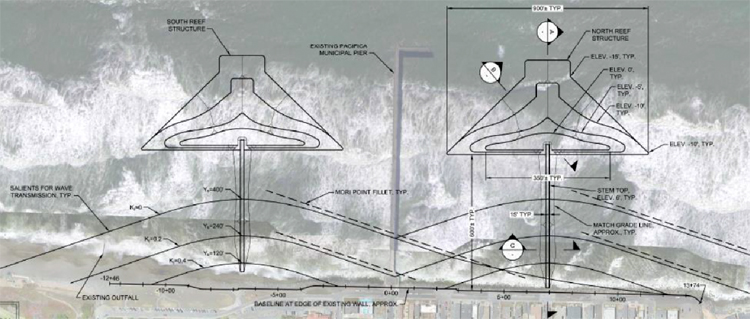
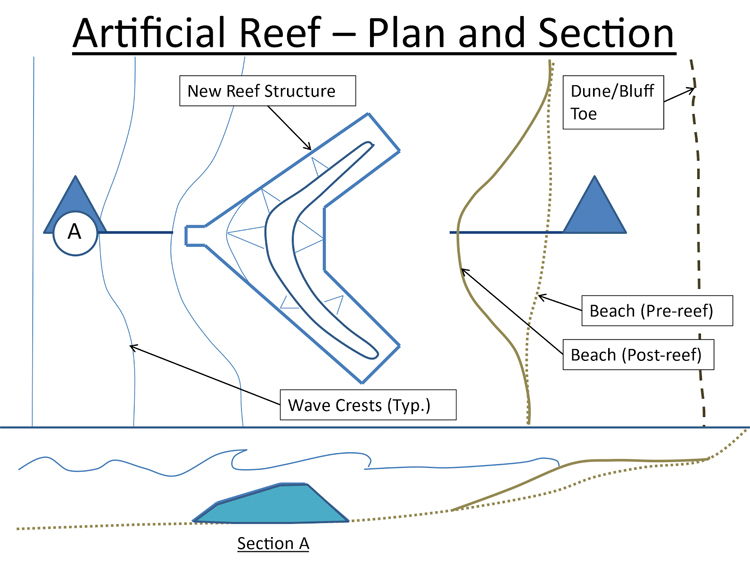
The concept described by the project’s advocates involves a triangular reef made primarily of rock, similar to the structure of the Palm Beach Reef on the Gold Coast of Australia. It’s unclear where the rocks will be sourced from.
The total volume of rock anticipated is roughly 110,000 cubic yards (Palm Beach Reef and Narrowneck are each about 80,000 cubic yards).
Researchers from the UC Santa Cruz Center for Coastal Climate Resilience are expected to participate in the modeling and evaluation conducted during the proposed feasibility study.
A key component of the proposed plan to replenish and protect the coastline is the “reef + sand” concept.
Under this approach, sand would be added to the beach initially (beach nourishment) and then the reef would help retain that sand, slowing erosion and creating a wider beach profile inside the reef.
Early construction costs put the price tag of the Pacifica reef at $45M USD. Given the complexity of coastal permitting in California, a full construction timeline could easily extend 5–10 years from concept to completion.
Anticipated Results
The Pacifica reef proposal is intended to achieve multiple goals simultaneously: coastal protection, improved surfing and ecosystem enhancement.
When waves break directly against a seawall, they tend to reflect energy and scour sand away from the shoreline. Over time, this can lead to the disappearance of the beach entirely.
The Pacifica reef will modify this process by:
- Causing waves to break offshore
- Reducing wave energy reaching the beach
- Encouraging sand to settle in the calmer water behind the reef
This phenomenon is known as wave attenuation and sediment trapping. The reef effectively acts as a submerged barrier that promotes the formation of a wider beach profile. This is a well-understood process can be seen in multiple human-made and natural locations around the world.
Proponents believe the reef could reduce erosion along Beach Boulevard in Pacifica and extend the lifespan of existing shoreline infrastructure. The reef could also help reduce the need for repeated sand nourishment, which can cost millions of dollars over time.
Surfing improvements are an additional explicit goal of the project. The Pacifica reef would be designed to shape waves in ways that create longer, more predictable rides left and rights by focusing ground swell and causing it to break in a more predictable, surfable shape.
The initial reef designs would create a left and a right. With plenty of northern pacific exposure there is no lack of swell. This will certain be one of the reef design considerations.
Proponents have suggested the reef could produce contest-quality waves, potentially making Pacifica a destination surf spot.
The Pacifica reef could also become a productive marine habitats. Hard surfaces in otherwise sandy seabeds provide attachment points for kelp, algae, mussles and barnacles. These organisms attract fish and invertebrates, forming a small reef ecosystem.
Researchers studying artificial reefs in Pacifica are also exploring kelp planting, which could further enhance ecological benefits. Kelp forests increase biological diversity and reduce wave energy.
Community Support and Next Steps
The Pacifica reef proposal is one of the most exciting reef plans since Pratte’s Reef in the early 2000s, and its likely to be infinitely more successful if it goes as planned. This success stems from the hard work put in by a coalition of local surfers, coastal engineers, and environmental advocates.
Key figures involved in the concept include:
- Rob “Birdlegs” Caughlan – Surfrider Foundation’s first president and longtime coastal advocate
- Bob Battalio – coastal engineer specializing in coastal hydraulics
- Tom Kendall, Brian Gerrity, and George Domurat – engineers and coastal management professionals with decades of experience in shoreline projects
Their proposal has been framed as a multi-purpose coastal resilience project rather than simply a surfing amenity. The concept has also gained attention because it offers a nature-based alternative to traditional seawalls, which many coastal scientists criticize for accelerating beach loss.
The city and county have not yet committed to building the reef but they have, in partnership with OneShoreline, applied for a grant through the Shoreline Erosion Control Grant Program, which is administered by the California State Parks Division of Boating and Waterways. The application was submitted in February 2026.
The grant request is intended to fund a feasibility study for the artificial reef. The study would evaluate whether the reef would meet the coastal protection and surf improvement goals described above.
The total cost of the feasibility study is estimated at $150,000. The project team requested $75,000 from the state grant program, with the remaining portion covered by the City of Pacifica and OneShoreline through local funding and staff resources. The Shoreline Erosion Control Grant Program typically funds up to 50% of project costs, which is why the request was limited to half of the total study budget.
If funded, the study would likely take around two years and include coastal modeling, sediment transport analysis, and evaluation of potential reef designs. The results would help determine whether constructing an artificial reef could be a viable part of Pacifica’s broader efforts to address coastal erosion, sea-level rise, and storm impacts along Beach Boulevard.
Sources: Surfertoday.com, Len Materman, Bob Battalio, Robert Caughlan, George Domurat, Brian Gerrity, Tom Kendall