




Screenshot


RE:BEACH Oceanside Reef
A innovative, community-driven initiative for sand retention and restoration in Oceanside, CaliforniaAverage Reviews
Description
The city of Oceanside, CA has plans for an artificial reef that will improve surf conditions and help restore some of the sand lost to erosion. The reef is part of the RE:BEACH Oceanside project, a larger coastal resilience initiative designed to address the chronic loss of beach sand along Oceanside’s southern shoreline.
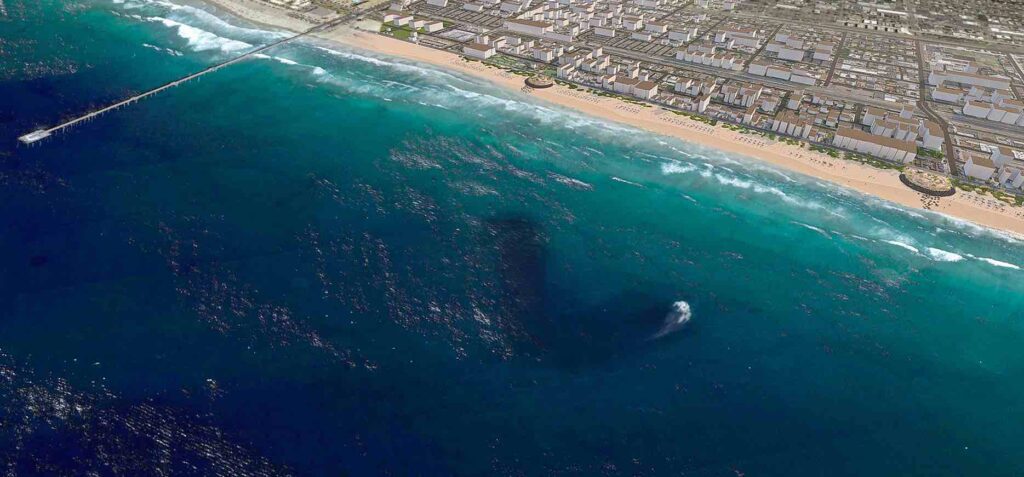
The design and testing process is still underway, but early models place a reef measuring roughly 820′ x 600′ about 900′ from shore. Given the shape and size, it’s likely to produce a point break that produces left and rights that run around 100 yards. The reef is likely to be constructed from sand bags and/or large rocks with a total volume of ~75,000 – 150,000 cubic yards (compared to 80,000 cubic yards in Palm Beach Reef).
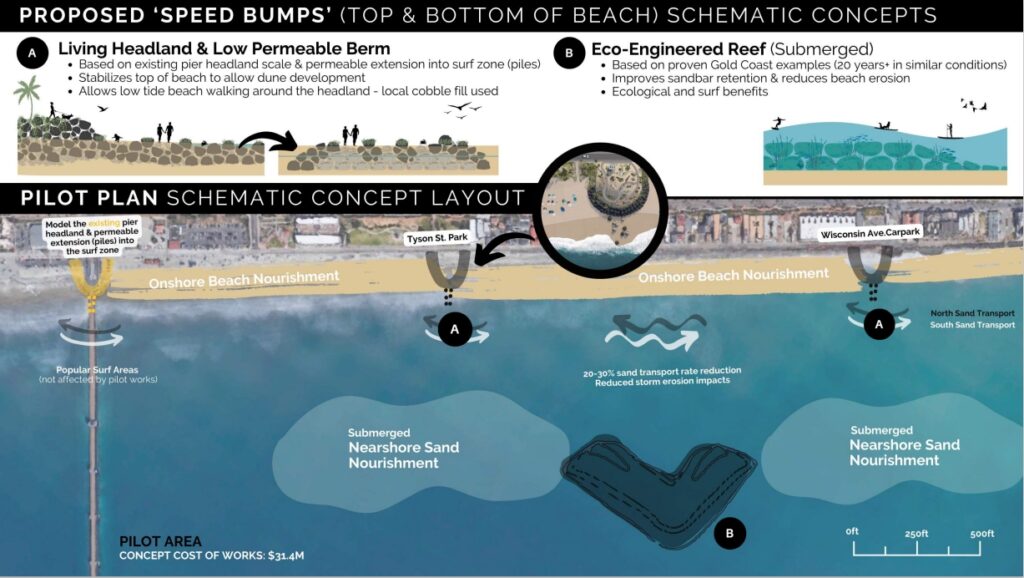
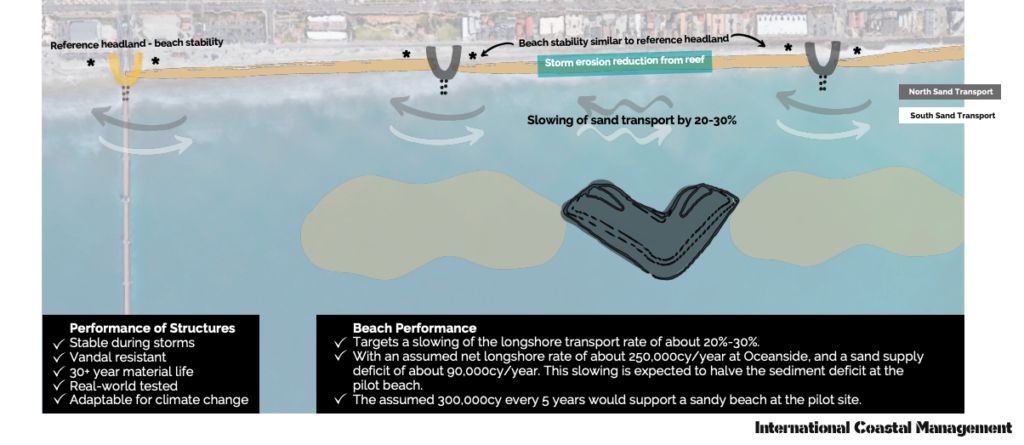
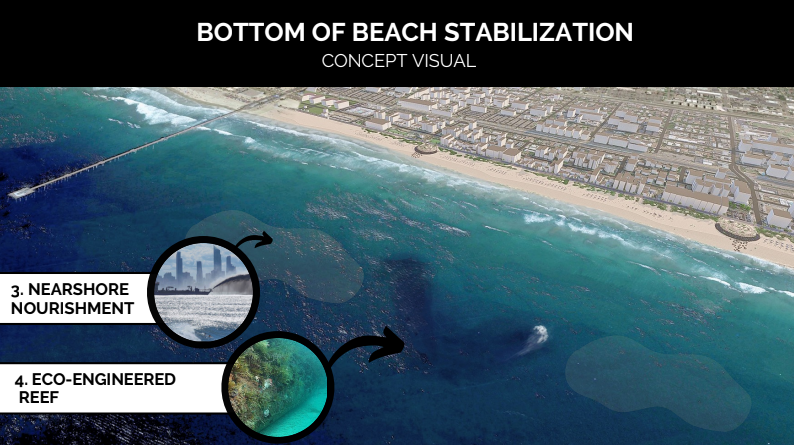
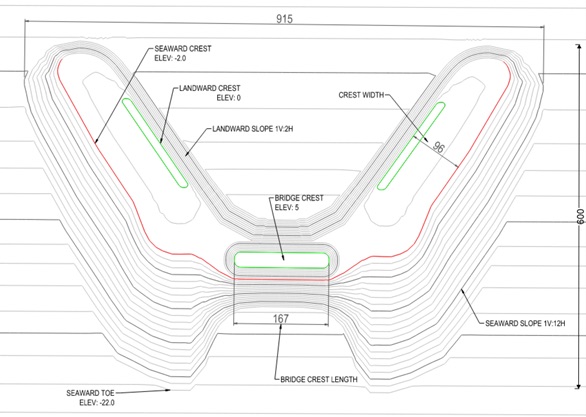
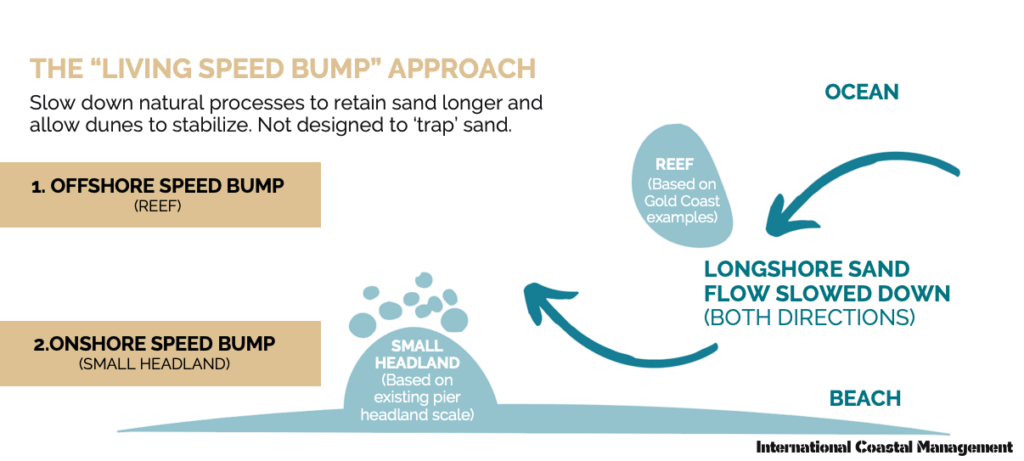
As of early 2026, the project in the the engineering refinement and testing phase, with both advanced numerical modeling and full-scale physical wave-basin testing underway to optimize performance prior to final permitting and construction. The environmental analysis and approvals have not yet been finalized, and the project design continues to be refined through modeling and physical testing. No permits have been issued, and no construction timeline has been approved. Overall, RE:BEACH has advanced into a data-driven validation stage, supported by $1.835 million in state funding and $2.27 million in related federal study funding, with final environmental determinations and design decisions still pending.
Design and Analysis
The artificial reef is part of a much larger project that’s intended to fix Oceanside’s relentless erosion problem. The attempts to “solve” the problem in the past will sound familiar: over time, more than 20 million cubic yards of sand have been added to Oceanside’s shoreline, yet large sections still struggle to maintain a dry recreational beach.
At one point, the city considered a traditional solution: a groin field. That proposal ran into immediate resistance, largely because of what coastal engineers already understand well—structures that trap sand in one place often starve beaches downcoast.
To generate alternative ideas, the city decided to it opened the problem up to an international design competition in 2023. They received 6 submissions and chose 3 as finalists each of whom approached the problem from very different angles. Some leaned toward nature-based coastal landscapes. Others proposed hybrid systems blending morphology and engineering. But the concept that ultimately won—developed by International Coastal Management (ICM)—stood out for a simple reason: it was grounded in something close to a working precedent.
Their proposal, called “Living Speed Bumps,” didn’t try to stop sediment transport. It tried to slow it down with a mix of on-shore headlands and an offshore reef.
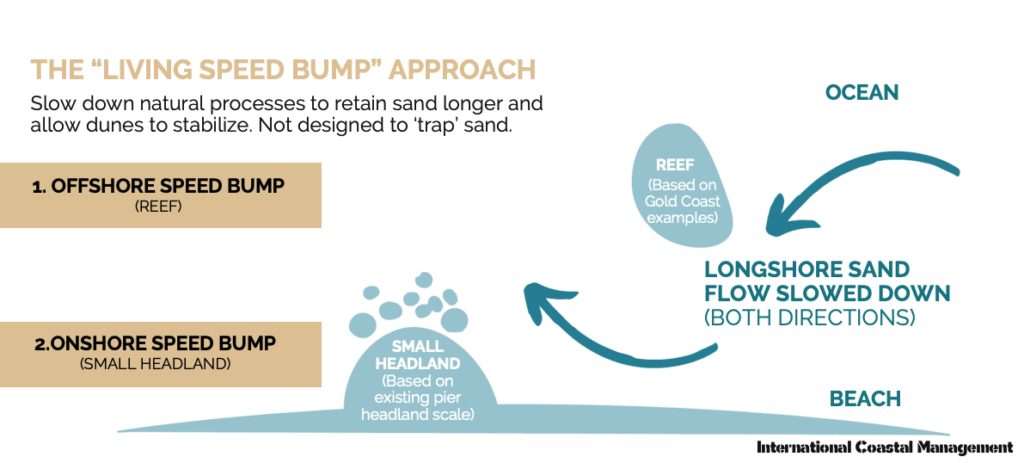
The idea is straightforward in concept, but subtle in execution: instead of building long, hard barriers like groins, you introduce a combination of offshore and onshore features that gently reshape how waves and currents move sand through the system. The goal isn’t to trap sand permanently. It’s to increase how long sand stays in the system—to give each nourishment cycle a longer lifespan.
ICM and RE:Beach took the next step in the digital domain. Engineers ran more than 900 numerical simulations across dozens of reef configurations, systematically varying things like crest height, orientation, and geometry. Each variation changes how waves break, how currents form, and ultimately how sand moves along the coast.
After narrowing down promising configurations through simulation, the team moved into physical testing at the O.H. Hinsdale Wave Research Laboratory at Oregon State University.
They built a 1:35 scale model of the Oceanside coastline—stretching from the pier down to the project site—inside a large directional wave basin. This is the closest thing you can get to “seeing the future” of a coastal project before it’s built.
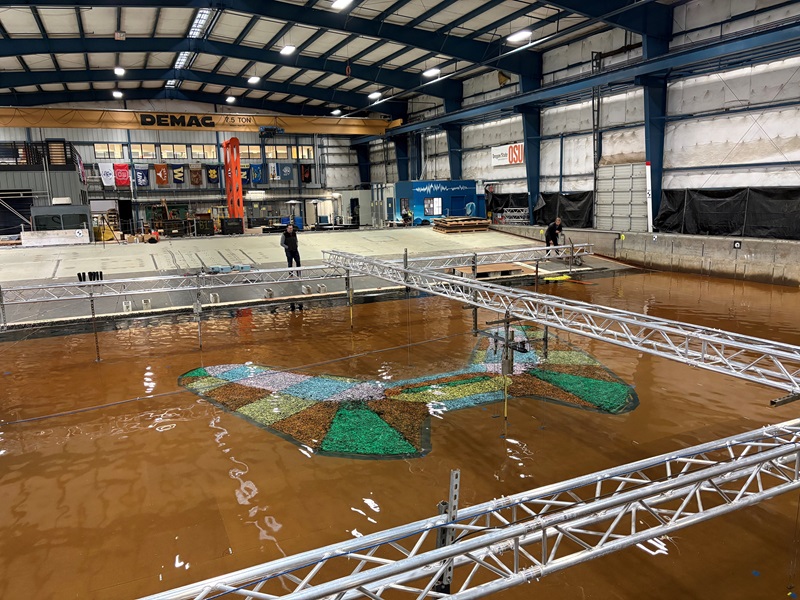
In this environment, waves can be generated at different angles, heights, and periods, simulating real ocean conditions. The model allows engineers to observe how waves transform over the reef, how currents circulate between the reef and headlands, and where sand is likely to deposit or erode.
The modeling should complete, and a near-final design for the reef should be revealed sometime in spring or summer of 2026.
In parallel to the digital and physical modeling, environment impact analysis is taking place. In October 2025, the City of Oceanside initiated formal review under the California Environmental Quality Act (CEQA) by issuing a Notice of Preparation (NOP) for a Programmatic Environmental Impact Report (PEIR). The PEIR is intended to evaluate the full sand retention system, including the offshore artificial reef and the two artificial headlands. By structuring the analysis as a programmatic EIR, the City is establishing an environmental framework that can support both the initial pilot project and potential future phases, i.e. more reefs, along the shoreline.
The environmental review is supported by a multi-year data collection program. Baseline monitoring has been underway since at least 2020 and has expanded through 2025. This work includes shoreline position tracking, beach volume surveys, nearshore bathymetric mapping, and offshore wave and current measurements using deployed instrumentation such as ADCPs. Additional monitoring efforts include biological surveys as well as surf and beach-use observations. These datasets are being used in conjunction with numerical wave modeling (Boussinesq-type models) to simulate wave transformation, current patterns, and sediment transport under various design configurations. The results of this modeling and monitoring program form the technical basis for evaluating environmental impacts under CEQA and for determining consistency with California Coastal Act policies.
Funding
The RE:BEACH project has secured state and federal support for analysis and planning, but not for construction. On April 9, 2025, the project received $1.835 million from the California Coastal Commission. This funding is allocated to baseline monitoring, technical studies, environmental review, and updates to key planning documents, including Oceanside’s Coastal Hazards Adaptation Plan, vulnerability assessments, and Local Coastal Program policies. No portion of this funding is designated for construction of the reef, headlands, or nourishment system.
In parallel, approximately $2.27 million in federal funding has been allocated through the U.S. Army Corps of Engineers to complete the Oceanside Special Shoreline Study. This federal effort is separate from RE:BEACH but addresses regional sediment management and long-term erosion mitigation, and may inform future implementation strategies. At the regional level, RE:BEACH was designated in 2025 by SANDAG as the Regional Sand Retention Pilot Project, providing coordination and regional alignment but not direct capital funding.
Eventually, more funding will be required. ICM expects the reef component to cost $7.45M, which is just one part of the larger $31M project price tag.
Anticipated Results
The RE:BEACH project in Oceanside is intended primarily to improve sand retention and beach stability along a historically erosive stretch of coastline. According to project materials, the combined system of an offshore artificial reef, two headlands, and ongoing nourishment is designed to reduce wave energy reaching the shore, slow longshore sediment transport, and promote localized sand accumulation (a salient) between the headlands. The stated objective is to extend the lifespan of placed sand and reduce reliance on repeated nourishment cycles, while maintaining sediment transport in a manner that does not adversely affect adjacent beaches.
With respect to waves and surf conditions, the project does not define a specific performance target. However, based on reef design thus far and previous experience, we can expect a left and right-hand waves that run for about 100 yards. Its not clear what swell sizes will make the reef “work”.
The project also includes objectives related to ecological enhancement, including the introduction of hard substrate and increased habitat complexity in the nearshore environment. However, biological impacts and benefits remain subject to formal evaluation through the CEQA process and ongoing monitoring.
The current schedule anticipates completion of environmental review and development of a permit-ready design by 2026, followed by construction durations of approximately 6 to 9 months for the headlands and 4 to 6 months for the reef, if approvals are obtained.
Sources: RE:BEACH, The City of Oceanside, International Coastal Management